
No more than governments should companies have to choose between a closed, scholarly, identity-based and sometimes autarkic model, and an open, mercantile, individualistic and purely opportunistic one. And the key to success is not “in the middle” either.
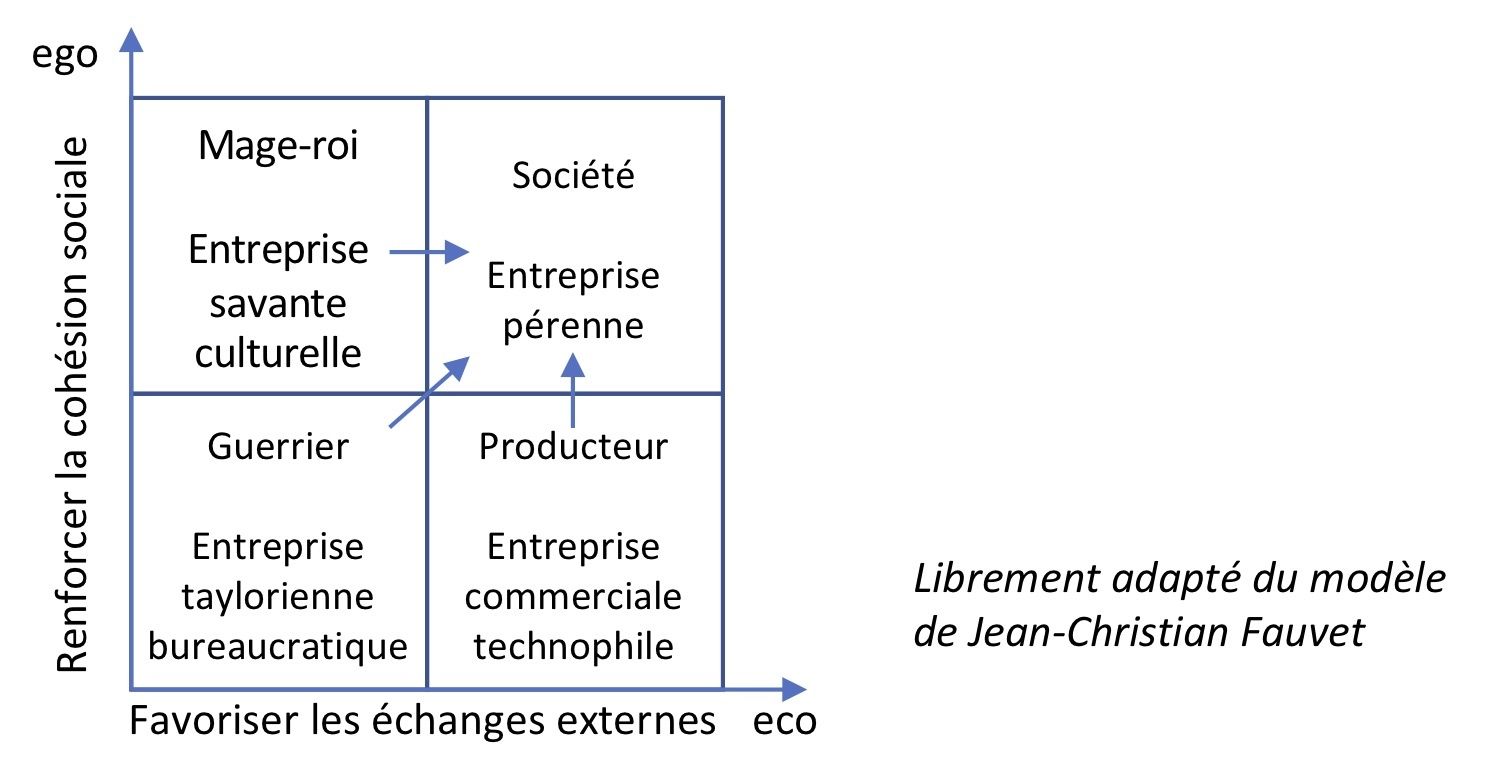
The openness and closure of a social group both have their uses, their virtues and their flaws. As Jean-Christian Fauvet showed with his “ego–eco” model, these two orientations are not on the same axis, and should therefore not be set against each other.
The “ego” dimension, which relates to closure, favours staying among one’s own, social cohesion, a shared sense of a common project. This dimension may refer to a “destiny”, to “values”. It can be a matter of incantation, of “communication”, when it is not translated into action. How many business leaders refer to this dimension, with more or less oratorical skill? But do they adopt internal policies, organisations and ways of working that give substance to this will to be together and, even more, to act together? Silos, functional or operational, clash – as do the members of the management committee – rather than working together…
The “eco” dimension, for its part, relates to openness, commercial conquest, innovation, change. Pushing for openness is essential to any economic activity, to win contracts, markets, material and human resources. This is the world of contracts and rational individuals. Some monopolistic companies – less in their actual status than in their collective identity, their culture – claim to be opening up to the world and to competition, by choice or by necessity. But while for some this is merely an oratorical exercise, giving a pleasant thrill to the inhabitants of a protective cocoon, others sacrifice their unity, their vocation, to a race of internal competition, to recruiting mercenaries who will tomorrow leave with their talents for other adventures. From one extreme to the other…
Collective ownership, trust, autonomy and responsibility
As one might imagine, the way forward is a delicate, ever-adaptive combination – depending on circumstances and on internal and external contexts – of the two dimensions, “ego” and “eco”, which, meeting according to their intensity (0/1), give four reference quadrants (00, 10, 01, 11). The first three correspond to classic corporate cultures (Taylorist and bureaucratic; scholarly and cultural; commercial and tech-loving). The fourth is that of modernity, of collective ownership, trust, autonomy and responsibility: it is the product of the strengths of the other three.
In the light of this analytical model, European companies have competitive advantages over their counterparts in international markets. And while many of our companies – and many of our fellow citizens – are suffering from the shocks of “globalisation” and are tempted by “protectionist” closure, all should embrace the cultural specificities of the companies of our old continent, which exist only through the women and men who work in them.
Culture, the result of a complex encounter
Indeed, a company’s “culture” is the result of a complex encounter between trades or vocations, archaic or changing organisations, laws and standards, ways of working acquired, chosen or inherited, conscious and unconscious – and women and men, at every level of responsibility, who are also (and above all?) individuals with their own lives, histories, values, attachments, myths and beliefs. So whatever the majority shareholder and the overall “governance”, a company based on European soil, and drawing on the talents of the regions where it recruits, is also (and above all?) a European company.
And European societies – and, surprisingly, to some extent Korean society, among others – were born of the tri-functionality of the ancient Indo-European civilisations (as described by Georges Dumézil): the warrior, guardian of the society’s survival in the face of danger; the priest-king, guardian of common values and laws; the peasant, who feeds the community.
In our modern societies, all three have changed.
The warrior (00) has opened up to adapt to asymmetric and hybrid conflicts, playing on alliances as much as on influence and unconventional actions. Internally, he has left the protection of sovereign functions to the law of the State and its agents.
The priest-king (10), in our European democratic societies, has seen his role split between the government of laws (the State) and the reference points of individual and collective beliefs (the Church).
The peasant (01) has become a merchant, engineer, inventor, conqueror…
But the three functions remain useful frames of reference, both in their specificity and in their indispensable union.
The balance of interdependence and alliances
Just as in our historical societies, our communities – and every company is one – can only prosper through the balance of these three functions. It is the contribution of each of these functions, their interdependence and their alliance that brought about the expansion of our continent. And it is still this balance that our companies must constantly seek.
Other traditions rely on other models: with an “eco” function pushed to the extreme but suited to the conquest of new spaces, resting above all on individual freedom, risk and contract; or an absolutist “ego” function, neglecting individual rights – which are nonetheless sources of fulfilment, creativity and innovation – in favour of an empire, a dominant and domineering collective that strips people of responsibility and is alien to the drive of free, creative man (and woman, of course, “man” being neutral here); or again autarkic, theocratic, autocratic models, which may appeal through the “closure” – and therefore the immobility – they offer, vie with one another in lyrical flights, but reduce the collective ego to a “providential” Ego, and the dynamics of win–win exchange to violent conquests or monopolistic relationships.
European companies, for their part, developed on balanced, fertile ground, which the now globalised flows of capital, goods and talent change only superficially, and very slowly.
Embracing this cultural capital to regain an active place in markets
Embracing this cultural capital means both strengthening human potential – the main source of wealth for our companies – and regaining an active place in markets. Today, many talented individuals have made this choice by moving abroad, to free their capacity for initiative. These expatriates have not all abandoned their identity – and in any case they are, consciously or not, its product – valued by international recruiters.
These individual paths should inspire European companies looking for cohesion as much as for markets: developing their human capital by nurturing the sense of a collective adventure, developing talent and a taste for initiative, and producing wealth that contributes to the common good, in synergy with others – which the practices of the modern digital world both allow and demand.
Leave a Reply