
Published in 2020 by Jean-Baptiste Colas, a French Army officer posted to the Defence Innovation Agency, « Innover en plein chaos » (Innovating in the midst of chaos) is a short, dense but well-designed book – and a fine illustration of the necessary exchanges between the military and civilian worlds.
Innovation is an indispensable quality and practice for the military world, engaged in the eternal race between sword and shield… And chaos, as it is usually perceived, is a paroxysmal feature of conflict. What a promising combination, then, is the title of this enjoyable book (full of treats for military buffs), structured in short chapters illustrated with military “case studies”, from the most ancient (Ramses II) to the most recent (the 2015 terrorist attacks in France).
Its framing is also flattering, since the preface is by Cédric Villani, the famous mathematician, and the afterword by Emmanuel Chiva, director of the Defence Innovation Agency.
So, while those curious about military affairs will find plenty here (my attention was drawn to this book by IRSEM’s podcast « Le Collimateur »), why recommend it to more “civilian” readers too?
First, because it expresses, in an original form, concepts that practitioners of change and innovation will recognise, even if they know them under other names. And also because it shows how fruitful exchanges between the military and civilian worlds can be, especially when crises spread to every area of society…
Strange attractors
This book makes you think. It also makes you smile.
For example, when Cédric Villani quotes the great mathematician Henri Poincaré to illustrate the lightning flash of innovative thinking. Because Henri Poincaré is also behind the “three-body problem” which, at the very beginning of the 20th century, laid the foundations for the unpredictability of physical systems and, through it, for what would become “chaos theory”[1]: an inspiring movement, in the late 1980s, around this sometimes catch-all term, complexity, unpredictability, fractals…
Likewise when Emmanuel Chiva asserts that “chaos is sensitivity to rupture”. While he is probably referring, with this phrase, to the “bifurcations” of complex systems – some of which can lead to chaos far from equilibrium – chaos is also “sensitivity to initial conditions”. The flap of the butterfly’s wing, or the faulty nail in the horseshoe that causes a military manoeuvre to fail…
Perhaps this book would also have deserved a few references to scientific approaches to “chaos”, beyond its everyday meaning. These would in particular have supported reflection on taking into account, within chaos, “strange attractors”: fields of possibilities in which precise predictability is impossible, but which are fertile spaces of equilibrium at the edge of chaos. Spaces of liberating, creative, yet safe disorder. And so harmonious, in fact, that one cannot fail to be struck by the beauty of the easily accessible digital representations. Forms also found in the living world, in the self-organised ballet of flocks of starlings or shoals of fish. Probably what Jean-Baptiste Colas calls “blocks of opportunity”.
In contrast to these strange attractors, where unstable equilibria dominate – a characteristic of life – reigns the anarchic chaos to which purely linear, stubborn and proud approaches lead when confronted with complex contexts to which they are not suited. Perseverare diabolicum, as we shall see…
A creative chaos?
In everyday language, chaos is often equated with disorder. But the author helpfully distinguishes two types of chaos: destructive chaos, certainly, which warriors sometimes encounter, but also creative chaos, which can be the source of creativity and innovation, if one is willing to welcome it.
This positive acceptance of a term a priori loathed by rigorous, programmatic organisations is one of Major Colas’s central assertions – behind which one may perhaps sense the early frustrations of an enthusiastic young officer, already confronted with the cumbersome procedures of a sometimes bureaucratic institution, and who would sometimes like a little more creative disorder…
But is chaos “creative”, or simply a reality one has to “make do with”?
To think about this, the book offers many proposals in favour of freedom of action and acceptance of disorder and the unexpected.
Such as “not exhausting one’s resources in a desire for absolute control”, daring antagonism, favouring practical sense… but also “no longer believing that innovation carries within itself the energy of change”, and therefore also supporting human factors. All principles of action that can be found, in innovative companies, in the new project management practices that break with the “lean” of post-Taylorist production.
Because if anything is missing from this book, it is the parallels that could be drawn with these new methods born in the digital world, which now drive radical innovation in other fields, including industry and complex projects.
Take, for example, the “minimum viable product”. For Jean-Baptiste Colas, “freeing oneself from the impossible means taking the first step, even an imperfect one”. And indeed, by constantly seeking the “perfect” solution, and failing to take risks, one risks immobility. Innovating means getting started, even with an imperfect solution to be improved. As was the case with Roland Garros and his aircraft machine gun.
This approach, which breaks with that of classic projects, is the one used for many software tools and applications, sometimes released imperfect but whose rapid updates make it possible to correct defects as they are identified – often by the users themselves. And which make it possible to reach the market in time – to hit what the military call a “time-sensitive target”.
Breaking free of procedures?
Innovating even means breaking free of rules and procedures (which often spell out an “ideal” solution, with no weaknesses).
Of course, one will not do this lightly with a vital installation. But when that installation is under imminent mortal threat, is it not justified to take a risk, to adopt a solution that is imperfect, or even not compliant with “procedures”?
As we read, history is full of examples of such “disobedience” that saved the situation, whereas following “procedures” would have led to failure. And the book gives some examples, such as Murat’s charge at Aboukir. Which can be compared, in the civilian world, to “Sully”’s initiative over the Hudson.
Along the same lines, the author also recalls Leclerc’s daring at Kufra – his vision, his courage, his “leadership” – in the service of French arms…
But in the organisation of the time, he was rather free (one could even say “isolated”) at the head of his troops. And his courage and boldness could be exercised without any real obstacle, apart, of course, from the enemy. Could he have exercised the same “leadership”, the same capacity for initiative, in a more structured, more bureaucratic, more standardised context?
I had noted, a few years ago, that Airbus had set up its most innovative organisation, A³ (“Acubed”), tasked with imagining the aviation of the future, in California… Some might have thought it was a Silicon Valley fad… But in 2015, it was no longer a “fad”. Was it because of less rigid regulatory constraints, which made it possible to experiment more freely with drones and human propulsion? Perhaps. But one cannot rule out that, far from headquarters and “corporate” rules, some felt it would be easier to “think outside the box” – and therefore to truly innovate, by taking risks…
Anti-consensus
This question of “leadership” is obviously central to the young senior officer’s book. It is the question of the “leader”.
“Innovation starts out as anti-consensus”. Here again lies the question of decision-making in a complex, hierarchical, standardised organisation. Who is in command? Who takes the risk? Who bears the responsibility?
The soldier’s ethic provides clear answers to these questions. But military personnel are both soldiers and civil servants, and the “war leader” must also operate within a standardised, bureaucratic organisation.
Since this is about innovation, one can of course refer to epistemology, and in particular to Thomas Kuhn’s “The Structure of Scientific Revolutions” (necessarily complemented by “The Road since Structure”, which puts paid to ideological uses of his first book). Is it possible to truly innovate – to achieve a “deep innovation” – when its assumptions are held by a minority?
The book’s examples of military operations, like Kuhn’s theses – and of course so many examples of success in companies – show that it is possible to innovate in a large organisation when there are enough degrees of freedom. Or when one stays “under the radar” long enough to arouse neither the jealousy nor the interest of the “bureaucrats”, until the innovation becomes unavoidable: the moment of the Kuhnian “scientific revolution”.
For Jean-Baptiste Colas, innovating also means fighting persistence in error and resisting loss aversion. It therefore means accepting to “start all over again” in order to step outside one’s usual framework. In other words, one might say, to “change paradigm”.
A parallel can be drawn here with approaches to organisational resilience, applied in complex, life-critical contexts such as military operations…
According to these theories and practices – unlike those that respond to simple, linear threats – the objective is less to prevent damage, in vain, than to ensure the survival of the organisation. Accepting blows, but continuing the fight. Losing battles, perhaps, but winning in the end – and not a Pyrrhic victory – to accomplish the mission and ensure the survival of the nation. Approaches that belong to the paradigm of accepting complexity, rather than to that of vain control.
The need for collaborative work
Finally, this confrontation with complexity, and with chaos, also means the need for teamwork and collaborative practices – the opposite of the vertical temptation.
Drawing on Machiavelli, the author recalls that one must “above all not try to shut oneself away as danger approaches. Still less from the ‘people’, who in innovation represent the user of the new”… The user’s point of view, the user-centred approach – again a key point of the new agile project management (not the perverted fashion for agility, but the real principles of the Agile Manifesto). And teamwork, of course, as Jean-Baptiste Colas recalls, attributing to Thomas Edison the creation of the first FabLab: “a culture of teamwork that makes it possible to create more effectively thanks to the complementarity of talents”. Including by accepting confrontation, friction, as a “source of opportunities and therefore of new things”.
With these two points – openness and teamwork – any resemblance to the handling of a recent crisis would probably be purely accidental…
To mention another source of inspiration, the founder of sociodynamics, Jean-Christian Fauvet, described a type of organisation suited to this capacity for initiative – and therefore for innovation – within a larger, more solid whole: “holomorphic” organisations. An idea the author expresses in his own words, referring to the organisation of special forces. To prevent mistrust between teams and preserve overall cohesion: a “choice of teams, independent but networked”. An organisational model proven, then, by warriors and entrepreneurs alike.
All the principles mentioned here are only examples of those set out in this book, which is therefore worth discovering, for every kind of reader.
Because by drawing on military examples confronted – beyond the “fog of war” – with “chaotic” situations to promote the strengths of fluid, complex approaches, Jean-Baptiste Colas makes an effective case for innovative practices, addressed to a cultural world not always ready to “let go”.
A characteristic fully shared by other environments in the civilian world.
Welcome to the world of chaos!
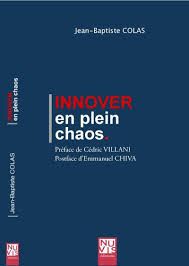
Jean-Baptiste Colas, « Innover en plein chaos », Nuvis Éditions.
[1] For the curious, I suggest considering the logistic map: X(n+1) = a·Xn(1–Xn), which describes the evolution of a population over time and which, despite its particularly simple form, can behave chaotically depending on the value of a…
Leave a Reply