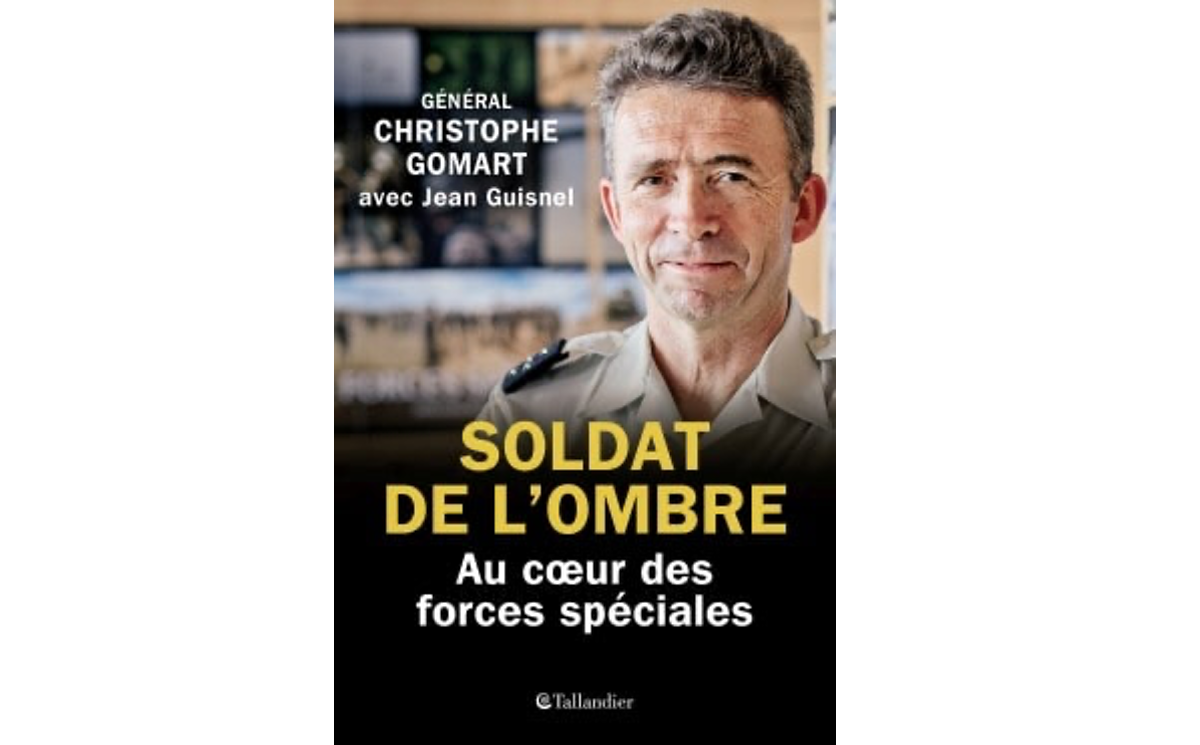
Yet another book on special forces? What is more, written not by a historian or a journalist, but by one of their commanders until quite recently? Add the spice of a media controversy about the secret services, and you have a book one reads eagerly, even greedily… But beyond the stylistic exercise and the book’s own purpose, it is also a useful source for civilian entrepreneurs…
General Gomart’s book stirred up the small world of military buffs at the end of September, as well as that of curious readers in search of thrills… When it came out, the focus was mainly on the general’s proposal – three years after donning the “chapeau mou” (the soft hat, as the French army calls the move to civilian life) – to merge the teams of the DGSE’s Action Division (the French foreign intelligence service’s covert operations unit) with those of the Special Operations Command (COS). Action Division, special operations: for non-specialists, we are right in the world of “Le Bureau des Légendes” (the French TV series known in English as “The Bureau”)… Many people love it, others find it irritating… Three years after he left the service, why this book – co-written, it should be stressed, with Jean Guisnel, one of the all-too-rare French defence journalists, a specialist and the author of many well-documented books on the secret services? We will not answer that question here; specialists may know at least part of the answer… a bank shot off three cushions?
What makes such a book chiefly interesting for the business world, apart from a general military culture that is always worth developing, is the confirmation that without interpersonal relationships, no organisation can deploy effectively. Even in a field as restricted and, a priori, as codified as this one (even if special operations means doing things “differently”, that “differently” is highly documented), procedures never prevail over human dynamics!
Above all, individual relationships
In his book, General Gomart recounts some of the operations he took part in or was in charge of… Yugoslavia, Afghanistan, Libya, Mali… For each of them, many books already exist. Written by journalists or by servicemen, they are obviously more complete than the brief accounts in this book of memoirs and proposals, which complements, illustrates and also embodies them.
Because what is striking in this book is the “naming”… And one sometimes wonders whether the mention of all these protagonists comes from the General’s memory or from Jean Guisnel’s detailed, well-documented knowledge. It doesn’t really matter. There are names – lots of names.
And this reveals that even in situations that pit States or para-state organisations against each other, or bring them together, one cannot move forward effectively by relying solely on organisational approaches and procedures. At every moment, the system has to be unblocked, people convinced, things explained, the operation moved to the “top of the pile”. Including, and above all, because lives are at stake, because responsiveness will make the difference between success and failure. And for that, interpersonal relationships have to be taken into account, even organised… classmates from military academy, fellow operators, earlier encounters… Relationships that can make things easier – or block them when the past has been conflictual.
Most civilian entrepreneurs know this… but some, particularly in large organisations, remain convinced that with procedure and authority, results will follow… We recommend this book to them.
Changing organisations, or leading people?
And yet, despite these descriptions of many individual interactions, the General recommends a strong organisational and symbolic change: merging the teams of the DGSE’s Action Division with those of the Special Operations Command.
To put it simply, what distinguishes the former today is clandestine, unacknowledged action, whereas the latter always act in France’s name. Whether they operate in civilian clothes or in uniform is, apparently, secondary. As for anonymity, in the age of social media and facial recognition, the General says it is a thing of the past.
What would justify this merger is the need for synergies between brothers in arms who rub shoulders more than they act together, as well as shared training and resources.
Beyond the technical issues specific to this world, these questions will no doubt be familiar to civilian readers, used to organisational changes in companies.
Should independent entities – similar but different – be kept, their synergies fostered, conflicts between decision-makers regulated, and resources allocated? Or should everything be merged into one big whole, with rationalised resources and clear “governance”? A big whole that will also, inevitably, be heavier and more bureaucratic.
While taking into account, of course, the real and symbolic interactions with the ecosystem and the relationships with “the Boss”. Since in this particular case, the two entities do not report to the same hierarchical level in the civil–military organisation concerned.
When choosing between these options, questions of power, real or symbolic, cannot be ruled out – neither in the military world (which, let us remember, is also an administration) nor in the civilian world. Because quite apart from any “rational” analysis, the fact that this proposal comes from a former commander of the 13th Parachute Dragoon Regiment (13e RDP) – a legendary elite unit and a pillar of the COS – and the son of a former commander of the same unit, is no trivial detail. Nor, no doubt, are the views on the subject of the journalist who specialises in the heroic operations as well as the “dirty tricks” of the Republic’s soldiers…
For civilian decision-makers, it is therefore essential, when faced with key organisational decisions, also to take stock of the morale of the “forces involved” and to identify, as far as possible, what drives each person’s actions and proposals. One is not just a title and a position. One is also a man or a woman, with one’s own history, context and convictions…
A taste for secrets, or a thirst for interaction?
When soldiers’ lives and France’s strategic interests are at stake – as the book illustrates many times – it is essential to know who the stakeholders are, and to understand their motivations and intentions as well as possible. Even when, by expressing them or letting them show, they take considerable risks. For themselves and for their cause. But this is the condition for trust, the prerequisite for joint action.
So when it is “only” a matter of commercial and industrial stakes, why do some take such care to hide their hand?
No doubt because, even if the stakes are not life and death, everyone gives meaning to their professional commitment, to their social existence, to the material comfort linked to their activity.
And no doubt also because many cultivate a “taste for secrets”. Sometimes out of caution. Sometimes perhaps also because the efforts you will have to make to uncover them will make you take an interest in them… A real question, particularly in large organisations, where some may feel they are treated as “pawns” or “cogs”. But not only there.
General Christophe Gomart, with Jean Guisnel, « Soldat de l’ombre. Au cœur des forces spéciales » (Shadow soldier. At the heart of the special forces), Tallandier, September 2020
Leave a Reply