
Some words are overused in our everyday business world. The word “courage” seems to be one of them. Especially after reading « Éloge du courage » (In praise of courage) by General Jean-Claude Gallet.
Military imagery is a staple of management literature. Especially when it comes to battles and leaders… though it draws, in fact, on a mythology, a sublimated imaginary, rather than on practice.
General Gallet’s book is a slap in the face. A slap to pessimism. A slap to pride. A short, powerful slap (only 140 pages), but a resounding one, because of the echo it creates deep within. A slap that can bring tears to your eyes, too.
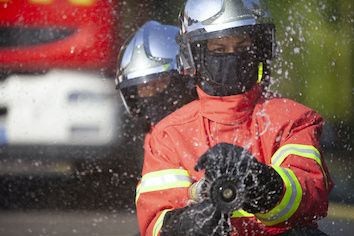
The author is known for commanding the Paris Fire Brigade’s response to the Notre-Dame fire. Perhaps also because his book, published at the end of 2020, was well received.
While it is certainly a soldier’s book, it is also striking because it describes “courage” through successive, complementary touches.
Portraits of soldiers and tributes to their bravery, certainly. “Soldiers of fire” who, unlike their brothers in other arms, have the particularity of being able to give their lives without having to take those of others. Because this relationship to death given and received is one of the specific features of military commitment – and the possibility of reciprocity is a real question[1].
Warriors too, more familiar to the collective image of the “combatant”. Because the author is above all a graduate of Saint-Cyr (the French military academy) who has commanded under fire – and not only that of the “dragon”.
And then also – and this is probably the most unexpected part for those expecting stories of combatants by choice – tributes to civilian heroes who, confronted with death and unprepared for it, also show what courage is. Resistance fighters during the war, of course, but also others whose bravery led them to face danger to save a life at the risk of their own, even when it was not their “job”.
And finally, the courage of the group, of those who hold firm, who do not give up. “There is this magic. A leader alone is nothing. Behind Churchill (…), there is also, above all, and above him, the English people. (…) Churchill has courage. But his people even more so”.
Others still, who held the hands of victims of terrorist attacks in their last moments. So as not to abandon our common humanity. And because the rescuers had to take care of the others, those they could still save. Courage, too.
The leader is not alone
So when I hear people talk of “managerial courage”, or regret “the lack of leaders” in companies, I often cannot help hearing, between the lines, a terrible and archaic attachment to “charismatic leadership”. The kind that gets drunk on providential men; that believes one man (or woman) can possess all the virtues needed to face every situation, even the most serious and complex. The kind that reduces “courage” to decision-making alone. Since the leader is necessarily alone, isn’t he? Alas…
So yes, the leader decides: “You have to take decisions alone. Take responsibility alone. But always listen to your men”. But this is not, most of the time, a sign of courage; it is the leader’s role, their responsibility.
Courage is something other than the solitude of decision. For General Gallet, “being courageous means having brothers in arms with you”.
Courage in a company, as in combat, is therefore not wanting to expose oneself alone at the head of one’s “troops”. Referring, consciously or not, to a certain “sense of sacrifice”.
Because whether this “sacrifice” is of family life, health or career comfort, it is merely a sign of misguided romanticism, of a purely symbolic death wish. Since commitment in a company is not devoted to destroying the other, but to creation, and therefore to life. Genevoix rather than Jünger. The game of go rather than chess.
And this collective dimension is also what makes the difference between courage and recklessness – or mere bravery. Putting oneself in danger – relatively speaking, given the circumstances – perhaps. But for what? For the thrill of risk, or for others? Because while the author regrets the extension of the precautionary principle, which “can provide a justification for every act of cowardice”, he considers that risks can only be taken for the benefit of others. Not against others. And above all not to flatter the egos of those who would have “sacrificed” themselves.
Because courage – that of the military leader, of the anonymous passer-by, as of the manager – is what gives the strength to turn towards others, and not merely to “sacrifice” oneself for them. “You know, kid, it wasn’t to play big brother that I gave you everything. What I passed on to you is for our men, your men, the ones you lead into fire. Never forget that you are responsible for them”. In these words of a dying lieutenant lies all the nobility of the charge of those who lead a group, or simply contribute to it, in their own way: the responsibility to pass on, and to help others grow.
Thinking of “courage” while thinking only of oneself – as a “heroic” leader – is to forget one of the key terms of the equation.
Trust, the secret ingredient of courage
Managerial courage, then, is not just about guiding others, but moving forward with them. “Trust is one of the secret ingredients of courage”.
Contrary to the saying, the leader is never alone. Or else he is leader only of himself. Accepting dissenting opinions, criticism as well as good ideas. Trusting one’s superiors, one’s teams, one’s partners. Isn’t that the greatest risk of all?
In the warrior world, against the enemy or against fire, the question does not arise. The leader takes a decision that may commit the lives of others, knowingly. Team members go into combat with their skills, strengths and weaknesses. Because the mission can only be accomplished with everyone’s contribution, in perfect synergy. Because the leader orders and the subordinate obeys.
But in companies? Isn’t it “simpler” to mistrust others, the weaknesses of “human factors”, and to treat people as executing machines? Giving “orders”, invoking procedures, looking for culprits in case of failure…
What if courage, then, meant trusting?
Finally, when we talk about courage, we often talk about “heroes”. If only because “the nation creates heroes to serve a cause”.
Of course, Jean-Claude Gallet recognises the need for heroic figures. Not those who could do “everything, right now”, of whom he is wary when they act at the expense of fraternity. But those of the “heroes who have rocked the adolescence of so many generations”. Adolescence, the age at which one still believes everything is possible, when the imagination still matters. But an imagination from which the adult will be able to step back, with benevolent nostalgia. Because the figure of the omnipotent, solitary hero is not that of our complex world – unless our societies have become those of overgrown adolescents…
In our peaceful contexts – because even in a crisis like the one we are going through, lives are rarely immediately threatened – what is “courage”, and what is a “hero”? Courage is probably that of having carried on with the mission – all proportions kept, when one thinks of those, military or civilian, who risked or gave their lives for others, or for a unifying symbol such as a cathedral.
And since everyone can choose their heroes from distant or recent history, depending on circumstances, environment and the chances of life, do we have at our disposal a gallery of portraits of business women and men, when entrepreneurs are so often disparaged?
To each their own choice: a brilliant inventor, a captain of industry. Or a tenacious team leader, an outstanding technician who knew how to pass on precious skills, why not; a teacher devoted to the greatness of their calling, too…
Courage is within everyone’s reach
Because courage is within everyone’s reach: “too easy to blame the ‘nanny’ State for having taken responsibility away from individuals, or to point the finger at individualism. After all, it is precisely because each person, individually, (…) manages to take charge of themselves that the collective can function”.
One will probably not find here any trace of disagreement with Mathieu Laine, despite this teasing dig at the argument of his latest books. Because the lover of freedom will obviously agree with this statement.
But beyond the punchy slogan, it is an indispensable reminder of the collective dimension of courage, even when it is exercised individually. Particularly if one wishes to speak of “managerial courage”, which is only ever exercised within a group.
Because when General Gallet discusses the current crisis, and the courage some have shown, he speaks above all of the “front-line” fighters. Those who did not give up, despite the lack of protective equipment. In hospitals, certainly, but also, more simply, in supermarkets and in the streets. Because “it is unlikely that supermarket team leaders – the ‘front-line managers’, as they say – were able to give meaning to their missions”.
And also at the heart of what should have been the reactor of crisis management, when he arrived at the Ministry of Health, recalled to serve a few weeks after leaving the uniform, to find deserted floors and empty offices. “Our country is facing a hurricane like none it has known for several decades (…) but I do not find the atmosphere of a buzzing hive that such a situation demands”. “The crisis centre and the minister’s floor are at work. But where are the managers behind them? Where are those who should be driving the strategy?…”
Courage means implementing
Here again, General Gallet’s book perfectly illustrates the misuse of the term “courage” in the world of companies and public organisations.
Courage would be “taking decisions”? No: courage is carrying them through, implementing them. In the front line, not from afar, behind a screen. Because just as war cannot be waged at a distance, managerial courage cannot be exercised through harangues from a podium or from behind a screen.
We should not regret “the age of the Titans”, still less claim to belong to it.
Courage means taking our place, in our ordinary daily lives – or extraordinary ones, when the nature of our commitment or circumstances lead us there.
And for those in charge of a team, whatever its size, in calm weather or in a gale, “managerial courage” means encouraging initiative, bringing groups to life, knowing how to give meaning. Daring to act together. That’s already not bad, is it?
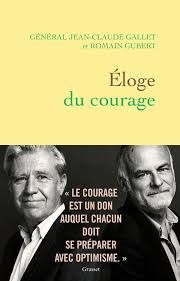
General Jean-Claude Gallet and Romain Gubert, « Éloge du courage », Grasset, November 2020
[1] To explore this question, listen in particular to a few episodes of the always excellent podcast « Le Collimateur », by IRSEM and Alexandre Jubelin (in French).
Leave a Reply