
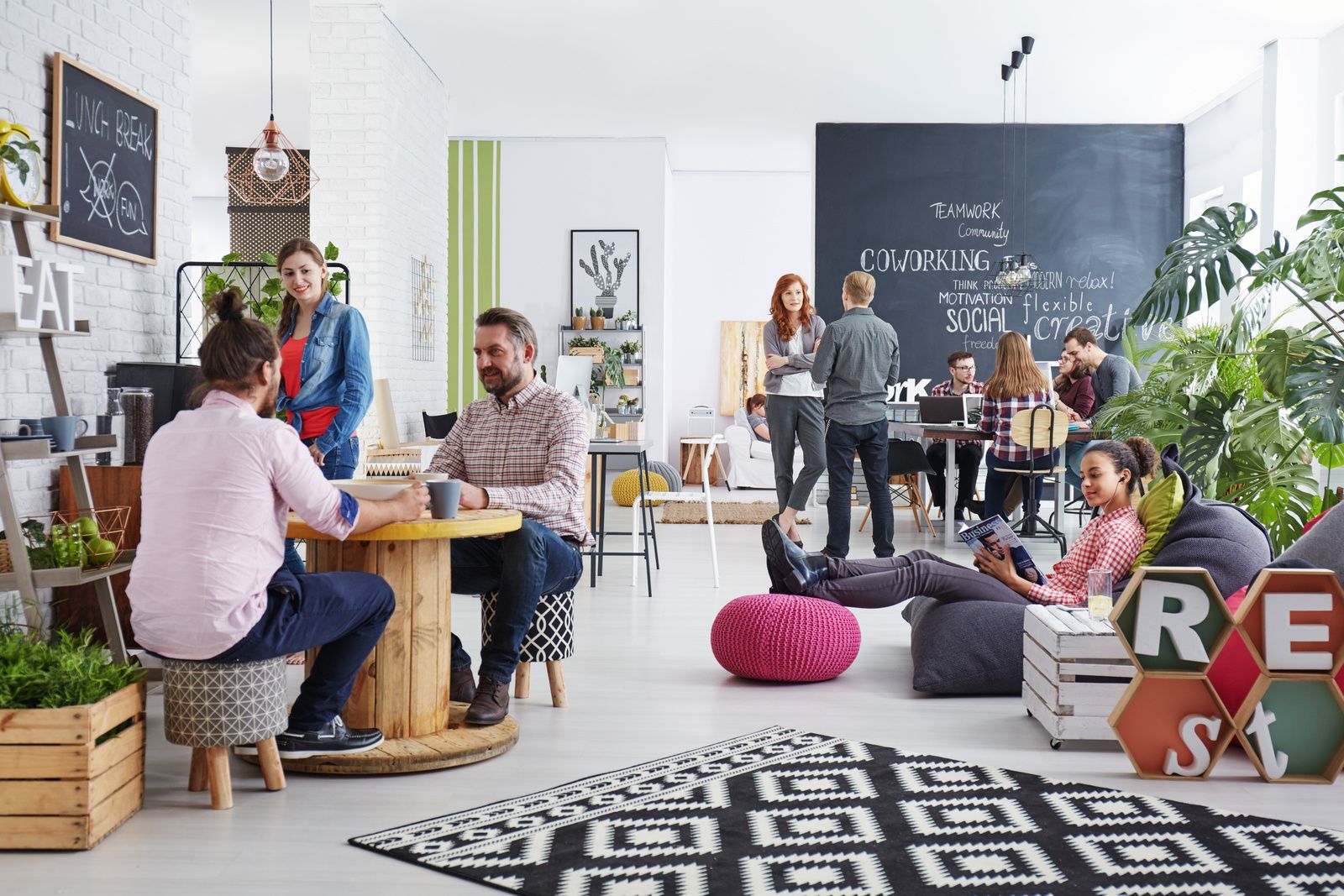
“Third places” – spaces between office and home – were cautiously emerging before the lockdowns. With “the aftermath” in mind, developers and property promoters are putting the subject back on the agenda. Will the lessons of “remote working” accelerate these shared workspaces? Not necessarily. At least, not without certain changes, in companies as in local areas.
“Remote working” seems to have won over many companies in the service sector, private and public alike.
Foremost among the perceived advantages is the opportunity to reduce the floor space rented or owned by pooling physical offices – what is known as the “flexible office” (or “flex office”). Because what appeals to company administrators in “remote working” (much less to managers) is working “at a distance”.
This way of organising work is not new, and many companies – particularly in consulting, whose employees are often away from “the office” – have used it for years. With effects that are now well known, positive or negative: indispensable paperless working (since document storage is kept to a minimum), a weakened sense of belonging (not everyone is comfortable without physical anchor points), competition for the “best” spots, workaround strategies with rules and goals more or less explicit and more or less related to the work itself, and of course the challenges of remote management and talent retention… Those who want to embark on it can at least draw on the experience of others.
On the employees’ side…
On the employees’ side – as our surveys during the first lockdown and in September showed – the desire is real, for part of working time (the two days a week expressed in our April 2020 questionnaire seem to be confirmed by the long negotiations still under way and by the practices people want).
Foremost among the advantages put forward for them is shorter commuting time (even if commuting can also be an essential airlock between the personal and professional spheres, a moment “for oneself” that is missing on the trip from the bedroom to the dining room, in the best of cases). There is also the stated wish for a better balance of life, which this time saving would allow. An advantage that has partly fizzled out for those who discovered, with varying success, the discipline the self-employed know so well – needed to maintain the fragile balance between the computer taking over the family dinner table and the opportunity to put on a load of washing between two files…
Foremost among the drawbacks, for most, is the weakening of social ties. Because the “physical distancing” imposed does not replace real interactions – even with, and perhaps all the more so with, the multiplication of two-dimensional video interfaces. Professional social ties, to adjust the necessary interactions more or less formally. And informal ones too, friendly or otherwise – let us remember that the workplace was one of the main places where couples met.
A favourable alignment of the planets for third places?
The “third place” was originally the idea of a neutral, community space (open to all who identify with its stated principles and/or style), one that encourages exchanges. A “home away from home” too, for some, because of its welcoming purpose.
So “third places” developed in bookshops, board-game shops… and very quickly in spaces with an “innovation” purpose, more focused on professional activity. Because the third place is in tune with the spirit of the times – that of the nomadic service worker – although the crisis has reminded us of the existence and importance of those who work “somewhere”.
And this idea of pooling space appealed to companies and professionals keen to reap the benefits of working “remotely” without the constraints and drawbacks of house arrest, voluntary or not.
Today, with the pressures on commercial property that are taking shape, professionals in the sector also see an opportunity to develop such spaces. Either by converting floors that are now empty, or as a new source of growth for their sector.
A favourable alignment of the planets, then, for the development of these new kinds of workspace to resume once health restrictions are lifted? It is not certain.
Third places will only exist in connection with mobility
The first obstacle to the development of “third places” is mobility. Because the world of work is not only urban, nor reserved for a population of “slashers”, “start-uppers” and freelancers whose working tools are a phone and a tablet, as an extension of a purely intellectual and highly individual activity. And when you live in a suburban area, going to a “third place” rather than to “the office”, when both are in the city centre, makes little sense (except, once again, for purely property reasons).
A third place becomes worthwhile if it reduces travel time. A journey that, as far as possible, will be made “without the car” – for environmental or economic reasons. So “third places” can only reasonably be located where mobility infrastructure and services already exist. First, to be able to get there. And also to allow travel during the working day, to reach larger urban centres or other “third place” hubs.
Heavy mobility (“mass transit”) will therefore always be essential, and in demand. And the development of third places could make an effective contribution to spreading peak hours, by keeping some travellers “on site” for at least part of the day, who will then use these services at other times. This is apparently the idea developed by SNCF Gares & Connexions (which manages French railway stations) – albeit on a modest scale in terms of time available – offering travellers friendly spaces in stations where they can work while waiting for a train. A modern, connected “waiting room”.
Logically, then, stations and station districts will be the preferred places to develop “third places”. And it is worth remembering that the pioneers of these services, for example in the Netherlands, set up in medium-sized towns, but right next to rail hubs.
The transformation of work, too (and above all)
The second obstacle the development of “third places” will face is the transformation of work.
Because using these services calls for skills and practices different from “remote working” as it is perceived today. Getting used to working in a space shared with other professionals who are not part of your company means betting on openness. With constraints on confidentiality. But also with opportunities from the encounters made – all the more so since third-place users can be “occasional” as well as “regular”. Here again, the experience of the pioneers should be put to use. For example, the principle of displaying available skills that other users of the space can call on.
A tremendous opportunity for collaborative work and synergies, for freelancers. But for company employees – a temptation, an open window?
Because while the “home worker” is isolated, and therefore captive – at least as long as their sense of belonging is not broken – the “shared-space worker” is potentially immersed in multiple interactions. Their added value and attention then become potential targets for approaches, well-meaning or not. To join another company or to go freelance, for example. Will companies and managers be able to prepare for this? To retain their talent. And why not use these opportunities to develop an “ecosystem” of skills and alliances?
Here again, the experience of international multi-site companies can offer some keys, since many of them pooled floors between departments, where your neighbour rarely belonged to the same function. Issues of competition and synergy within the company, certainly. But sometimes: “protect me from my colleagues – my competitors I can handle myself”…
So, beyond the opportunities for property savings, companies tempted by these new organisations will also have to invest in the finest transformation of all: that of professional practices.
Leave a Reply