
Mathieu Laine’s book « Infantilisation – cet État-nounou qui vous veut du bien » (Infantilisation – the nanny State that wishes you well) is both a bestseller and the subject of extensive media coverage, as well as many positive posts on social media. Brilliant, perhaps provocative, it challenges politicians and citizens. But also the entrepreneurs of “civil society”.
Mathieu Laine is a brilliant, powerful thinker. A committed liberal since his earliest years, he founded an original consultancy that confronts business leaders with the thinking of academics from every background. Top-flight stuff.
And his essay, concise and punchy, is a pleasure to read. Quick, too – at least at first. To be returned to later, directly or after exploring the avenues of reflection it opens up. And after reading, discovering or rediscovering the great classics of French and European liberal thought (Montesquieu, Tocqueville, Bastiat, Hayek, Molinari…) – some of which are available on the website of the Institut Coppet, which he chairs. As well as many recent articles from international research, on which he bases his argument. Not forgetting equally inspiring literary works.
Because that is the strength of his erudition and his work: offering many openings to help decision-makers in their choices. Strategic advice, then.
Revisiting, in the light of current events, a theme opened up in an earlier book (« La grande nurserie »), he was spoilt for choice for this one, so numerous have been the examples of bureaucratic absurdity and of infringements of public and individual freedoms in the handling of the health crisis – particularly in France, but not only. And you will no doubt have read in the press and on social media, or heard in his interviews, his many elegantly crafted, hard-hitting phrases on the drawbacks and dangers of “Big Nanny”. But this book cannot be reduced to them, and we can only recommend reading it in full.
And now, in practice?
After reading this inspiring essay, however, one key question remains. How do we do it? Because if we now know “what”, what about “how”? And that is often the limit of strategy: satisfying the intellect, shaking up ideas, helping decision-making, certainly… but in practice, how do we go about it?
That is no doubt the limit of the exercise for a compact book like this one, published in a series designed precisely to “recreate a space where the calm and demanding encounter of ideas can take place”. Ideas – not yet actions…
For this practical reason, then, but also because the “how” cannot be written in advance. It is practised, in confrontation with the complexity of technical, organisational and human systems.
We can, however, already identify a few foreseeable obstacles to implementing the recommended “de-infantilisation”. To think about “the next move”. The one that will ensure this book has not merely been an observation and an opening of perspectives, but an operational contribution to a necessary liberation of minds and energies.
Chaining Leviathan?
As regards public action, Mathieu Laine, far from giving in to the caricature of liberal thought that some would no doubt like to find in his writing, recalls that, according to the classics – and some contemporaries – the State has its full place in the organisation of society. The challenge is to keep it in that place. All of that place, but nothing more. And the challenge for public decision-makers is to resist the temptation to hold on to the power acquired during this crisis, and to succeed in “chaining Leviathan”.
In practice, for a public decision-maker – since, as his interviews remind us, he is listened to at the very top of the State – this will mean chaining oneself. Like Ulysses resisting the sirens’ song. And it will also mean chaining others, who have used and sometimes abused bureaucratic complexity to acquire, deliberately or not, a power that may be legal (and even then), but is in any case illegitimate.
Because anyone who has dealt with the workings of State services, local authorities or public agencies knows full well that the people working there are not always driven solely by concern for the public interest, economy of means and effectiveness. Or at least, even if the intention may be virtuous, the results do not always live up to these goals.
Examples of the human biases and weaknesses found there, as everywhere else, are many – and everyone no doubt has one or more illustrations.
Unable to influence one department, someone creates a rival one; worried about the future of their budget, someone opposes the success of a body working on a similar mission; jealous of a classmate from the same graduating year or of a manager from another career track, someone contributes to their failure, which will keep open the possibility of career progression for themselves, or for one of “their own”…
These abuses are sometimes the work of bureaucrats frustrated by miserable pay and by ways of working that strip them of responsibility, and that do not recognise their years of study or the skills they were promised they would use. Who is to blame, then? Not only those who, as tormentors, are also victims.
Or of administrative aberrations, such as the one we explored last November: the “exemption certificates” issued to national and local elected representatives during lockdowns and curfews. Some by another elected official, some by a civil servant (who is normally subordinate to elected decision-makers), some by no one at all – betting on the authority that would be imposed on any officer who dared to check the elected official’s card… But all of which opened up, for everyone and therefore for these elected officials too, a wide field of uncertainty as to how the officers on the ground, who hold the power of law enforcement, might behave… A legal uncertainty contrary to the rule of law.
A radical change of posture
Chaining Leviathan will therefore mean imposing on thousands of public managers and officials, civil servants or not, a radical change of posture and of practices. Moving from that of the representative of “public authority” (a dreadful term that has neither meaning nor legitimacy, since authority is individual, whereas power is organisational) to that of a “civil servant” – in the English sense, for which a French translation remains to be found.
A term that will no doubt horrify many, since our country is afflicted, in the world of private as well as public services, by the “servant syndrome” (one of the effects of the “logic of honour” described by Philippe d’Iribarne, which still holds true despite the three decades since the publication of that indispensable book, « La logique de l’honneur »).
This will not, of course, be the case for all actors in the public world and its offshoots. But it will nonetheless not be a small minority that has to be convinced, brought along and changed.
Because the public world – that of the State, but also that of local authorities, by imitation or competition – also too often lives, for individual and therefore, in aggregate, cultural reasons, in the myth of the “strategist State”: an “intellectual” image more flattering than that of “producers”, in a society that has also for too long sidelined the world of crafts and industry – and therefore of service to others – from career prospects and social representations. An image that allows people to feel valued at little cost, when material conditions and professional fulfilment do not.
A public world, too, unused to interacting with the private sector, and too often steeped in mistrust. Two characteristics that explain, for example, during the “first wave” of 2020, the exclusion of private healthcare providers from crisis management, even though their beds were empty and some were forced, because of the enforced cancellation of planned procedures and the absence of transfers from public hospitals, to consider short-time working…
A complementarity that is nonetheless necessary, and which Mathieu Laine calls for in his book, to “refocus the State on its essential missions”.
It is up to each of us to change
Changing will also mean – and the author writes this clearly – ensuring that each of us refuses the comfortable, responsibility-stripping embrace of the nanny State. Because this infantilisation is unworthy of our humanity. Because it is immoral, at least for those who cherish freedom. And because it is ineffective – the prosperity and creativity of our societies having been born of autonomy, initiative and the acceptance of risk. Some of us will accept this, and perhaps embark on a difficult detox. Others, sicker, more dependent, will be reluctant or even hostile. They will have to be helped, their difficulties, fears and resistance taken into account, and they will need support.
So, beyond the public sphere, to which most of us have no access except through our votes, how can we translate this plea for freedom into practice in our lives?
For this, our professional activities are a possible space for implementation, within everyone’s humble reach, and one that can effectively translate the fruitful reflections of this book into action.
Autonomy
The transfer of a large share of professional activity away from the office (“remote working”) has highlighted the difficulties and conditions for success of these arrangements – new for some, but already in place in many international groups, at least for working “remotely” if not “from home”.
The need for social interaction has been, and still is, one of the insurmountable limits to the social distancing that some call for, recommend or impose. But which they might dismiss by labelling it “non-essential”. Even if, whatever they think, our lives cannot be reduced to the two dimensions of a screen.
Autonomy is a condition for success, and it is a complex professional skill. Because it depends both on the nature of the activity (solitary or collective, productive or interactive…) and on all the stakeholders. On the person concerned, their colleagues, and their many interfaces, managerial or not, in the complex systems that our modern matrix or multipolar organisations are.
It is therefore not just a personal quality, which would make it easy to disqualify those who complain that they cannot be fully effective in isolation. It is a collective skill, which no doubt rests on everyone’s temperament and expectations, but also on the distribution of roles, making expected contributions explicit, and facilitating how the collective works.
To be free is to be autonomous. But in an organisation, a company, a human society, it does not mean being isolated. Autonomy, inseparable from freedom, must therefore be prepared. It is organised and practised, with trials, successes and mistakes. It is learned.
Resisting the temptation of procedures
The public sphere is not the only one invaded by bureaucratic, regulatory and legislative inflation – which strips people of responsibility, leads them astray, and leaves them at the mercy of deliberate or involuntary abuses.
Our companies must face it too. They have to incorporate every application of public measures. But they may also be tempted to add their own rules, specific to their business, their organisation, their managerial tradition.
Of course, bureaucracy and procedures have their reasons for being, and sometimes their advantages. In particular, they can provide clear frameworks for action in repetitive, predictable situations. They are reassuring, since they suggest that everything is “under control”, when uncertainty is, for many, a source of extreme anxiety.
But when the world changes suddenly – and that of our companies is an example, with changing competition, shifting legal frameworks in some countries, “human factors”, accidents, opportunities… – procedures are often unsuited. And when one tries to impose them “whatever it costs”, the outcome is often catastrophic, since the “user manual” cannot apply to a situation radically different from the one in which it was written.
In companies – and this is an advantage – it is often possible to regain control of these procedures, and to bring to light the immediate risks of their obsolescence or harmfulness. Because the “market” decides, in the end. And the decision-makers are identified.
So, before trying to free the world of public decision-making, are we sure we are ready, technically and morally, to exercise this freedom in our own companies?
Rediscovering managerial courage
Because then comes the question of courage.
Public decision-makers must, especially when facing difficult decisions, take the next election into account. If they are defeated because their decision is unpopular – even if it is effective in the long term – they will not be able to follow its implementation and steer it. And above all, they will have to face the feeling of failure, sometimes of rejection. A particularly painful prospect for those driven by hubris. And also, for those who do not come from the civil service, the risk of a difficult return to civilian life – even if the Republic is often indulgent, with its many opportunities in commissions or para-public bodies able to welcome bruised talents.
In companies, the risk is different. It exists, certainly. But the consequences of decisions are often more measurable, at least in part (because a company always operates in a context that is itself subject to contingency). And over a shorter term. Taking risks is therefore probably more within everyone’s reach. At least for those who see themselves as “decision-makers”.
Being free, and allowing others to be free, therefore requires courage. Because one can only promote freedom for oneself if one accepts it for others. It is a question of setting an example. And also of effectiveness. And while procedures reduce room for initiative and feed the myth of a smooth, untroubled course, “liberated” companies are those of risk-taking, of competitive tension embraced, of autonomy and responsibility. These virtues are in the hands of decision-makers and managers, at every level of the hierarchy – which, to be liberating, can only be as flat as possible.
Calling for the liberation of our society, after this uncontrolled expansion of interventionism, of infringements of freedoms, of infantilisation, will therefore only be credible if, in the context of our professional activities (and of course in our private lives, but that is another story), we have shown that, on our own scale, we are ready for it.
As Mathieu Laine writes, “the trap of the infantilisation of our lives lies ahead of us. If it closes, we lose everything”. So let us refuse to infantilise our staff, our partners, our customers. Let us free ourselves, and free them.
Then, in the world of public action too – which tries to impose itself on our lives beyond its function and its remit – we will be able to shake up established habits and show, with successes in hand, that instead of the road to serfdom, we consciously and responsibly choose the road to freedom.
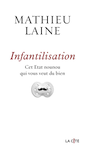
Mathieu Laine, « Infantilisation. Cet État nounou qui vous veut du bien », Les Presses de la Cité, 2021
Leave a Reply